



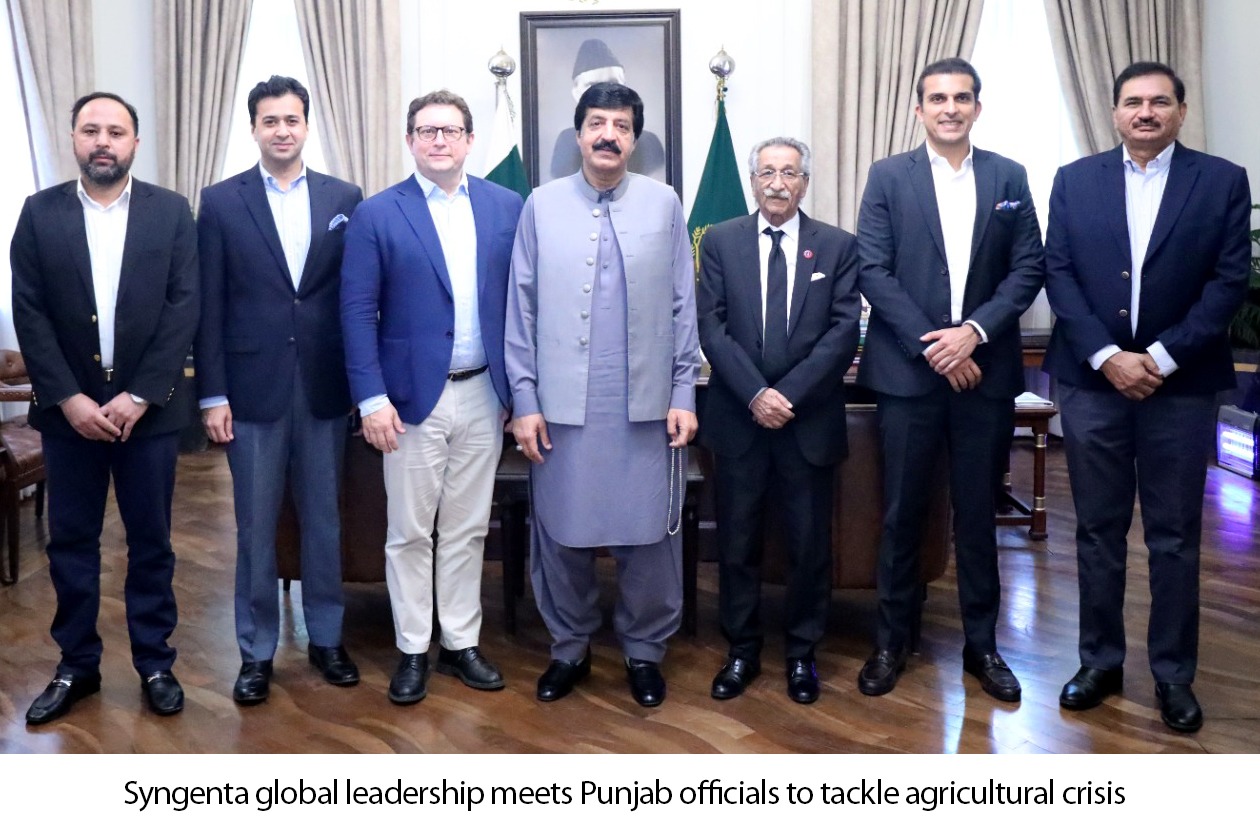
Senior executives from Syngenta, a global leader in agricultural science, visited Lahore this week as part of a broader engagement to strengthen collaboration and address evolving challenges in Pakistan’s agriculture sector.
During their visit, Syngenta’s regional leadership held meetings with the Governor of Punjab, Sardar Saleem Haider Khan, and the Secretary of Agriculture, Punjab, Iftikhar Ali Sahoo, alongside other key stakeholders. The discussions reflected a shared commitment to advancing sustainable agriculture and reinforcing Pakistan’s position within the global agricultural landscape.
Alex Berkovskiy, President for the Africa, Middle East and Asia region, and Jerome Barbaron, Business Head for Africa and the Middle East, were accompanied by Zeeshan Hasib Baig, Country General Manager of Syngenta Pakistan, and Ali Murtaza, Head of Corporate Affairs and Sustainability.
Pakistan’s agriculture sector, which employs nearly 40 percent of the workforce and contributes significantly to the production of wheat, rice, cotton, and sugarcane, continues to face increasing pressure from climate variability, including erratic monsoons, flooding, and prolonged droughts.
Discussions centred on the adoption of modern crop protection tools and bio-stimulants, and the regulatory reforms needed to bring them within reach of smallholder farmers. Syngenta’s leadership pointed to the taxation currently applied to agricultural inputs, including bio-stimulants, as a critical barrier that effectively prices out technologies designed to build climate resilience.
“Pakistan’s farmers are among the most resilient in the world, yet they continue to face a double burden,” said Zeeshan Baig. “This visit reaffirms Syngenta’s long-term commitment to Pakistan. We are here as partners in building a food-secure future.”
Provincial officials expressed openness to continued dialogue, with both sides underscoring the importance of science-based policy reform to support long-term food security.










Leave a Reply